
We hold every one of them.
MDRM is the Federal Reserve’s dictionary of call report line items. We hold every item, for every FDIC-insured institution, going back ten years, already here when you ask, with the inputs, the formula and the citation attached to every line.
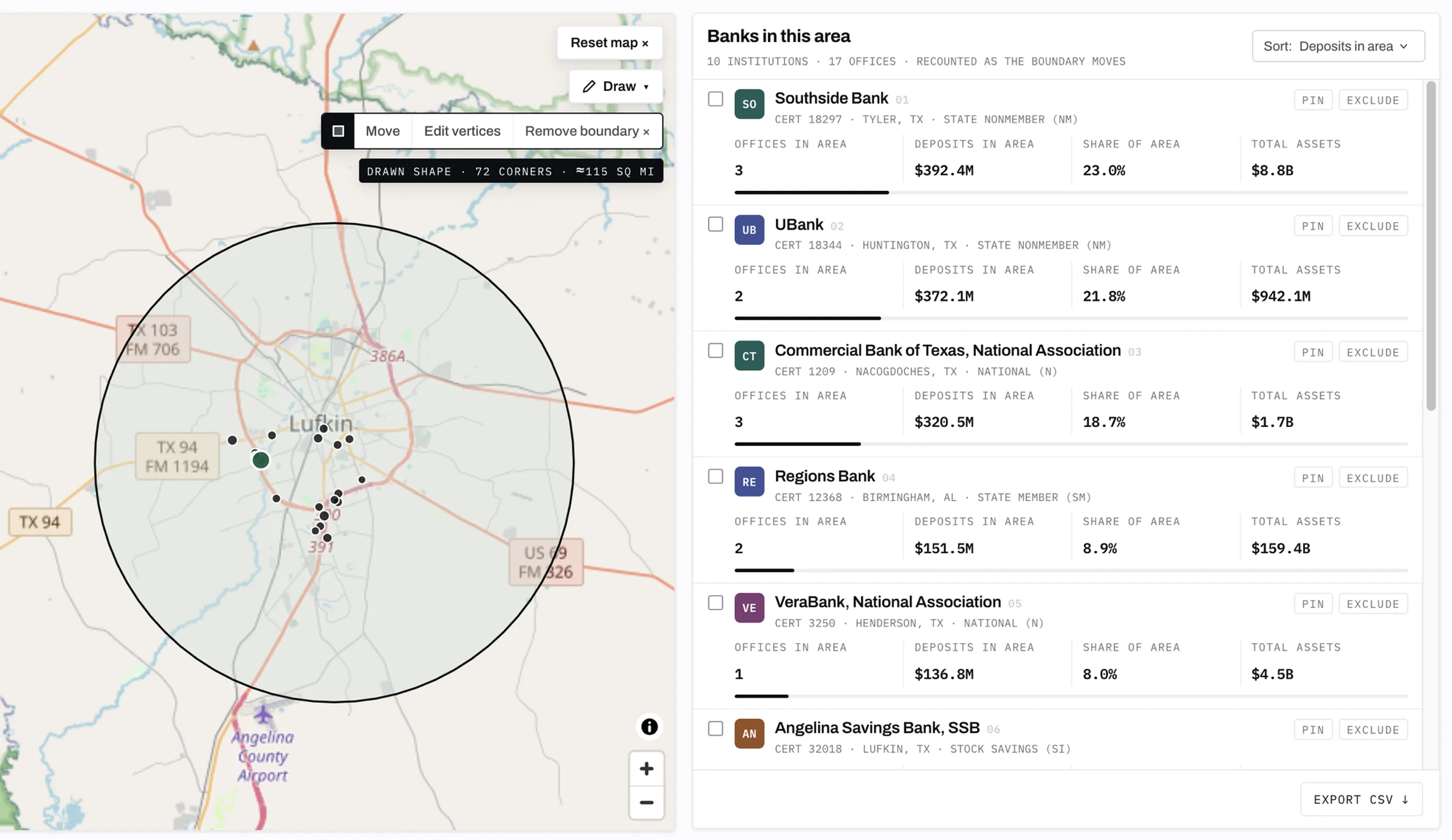
Plate. A drawn shape of ~115 square miles over Lufkin, Texas — 72 corners, 17 offices marked, 10 institutions inside the boundary, largest share 23.0%. Membership comes from the FDIC branch survey and every count recounts as the boundary moves. Six of the ten are shown; the panel scrolls. Captured 27 August 2026 · Call reports Q2 2026 · FDIC Summary of Deposits 2025 · a bank that did not report a measure is excluded from n, never imputed · Basemap © OpenStreetMap contributors
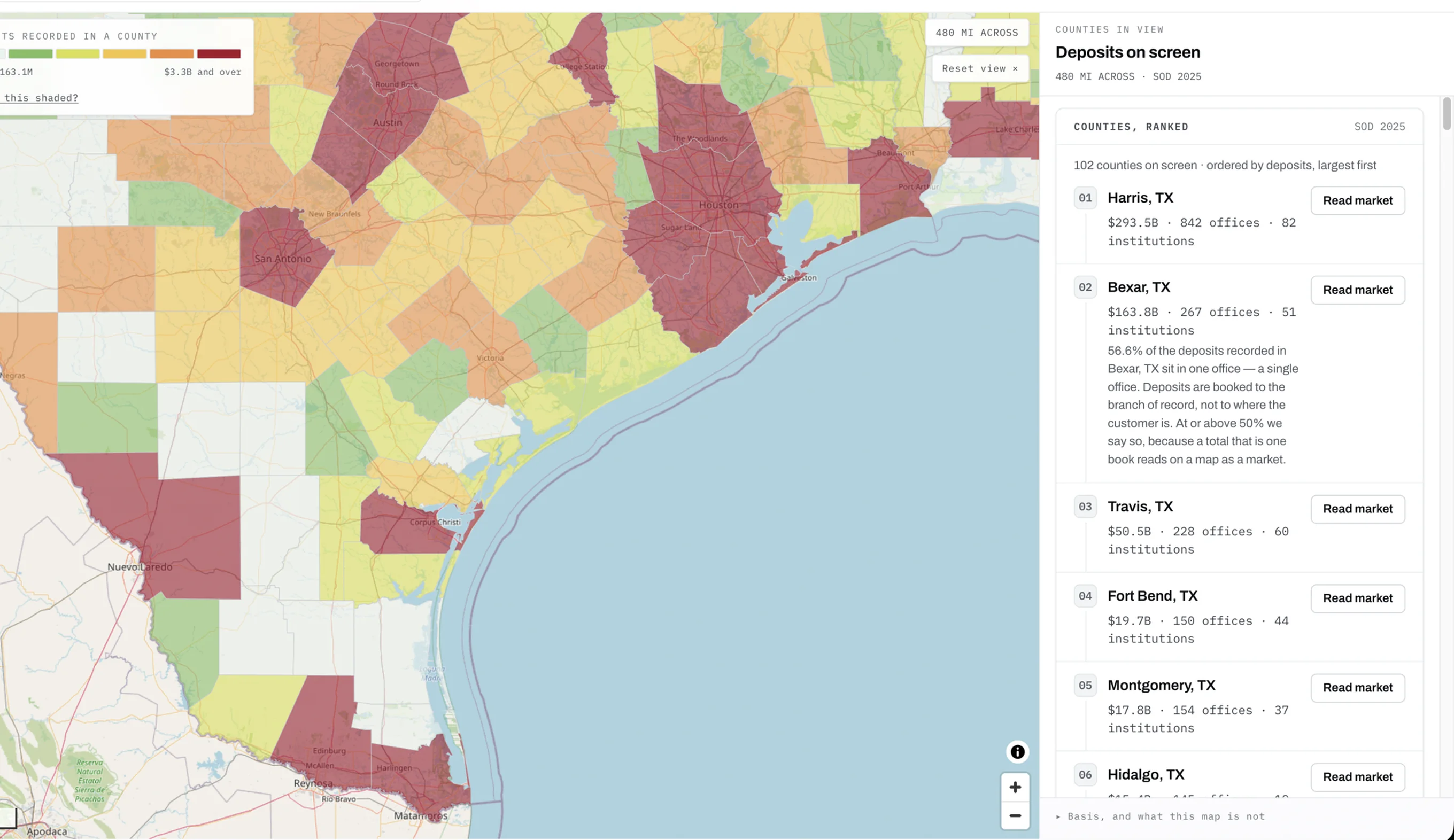
Plate. 102 counties on screen, ranked by the deposits recorded in them — Harris, TX largest at $293.5B across 842 offices. Bexar’s row carries the branch-of-record note: 56.6% of its deposits sit in one office. Captured 27 August 2026 · Call reports Q2 2026 · FDIC Summary of Deposits 2025 · shading is by quantile of the counties in view — a rendering device, stated as one · Basemap © OpenStreetMap contributors
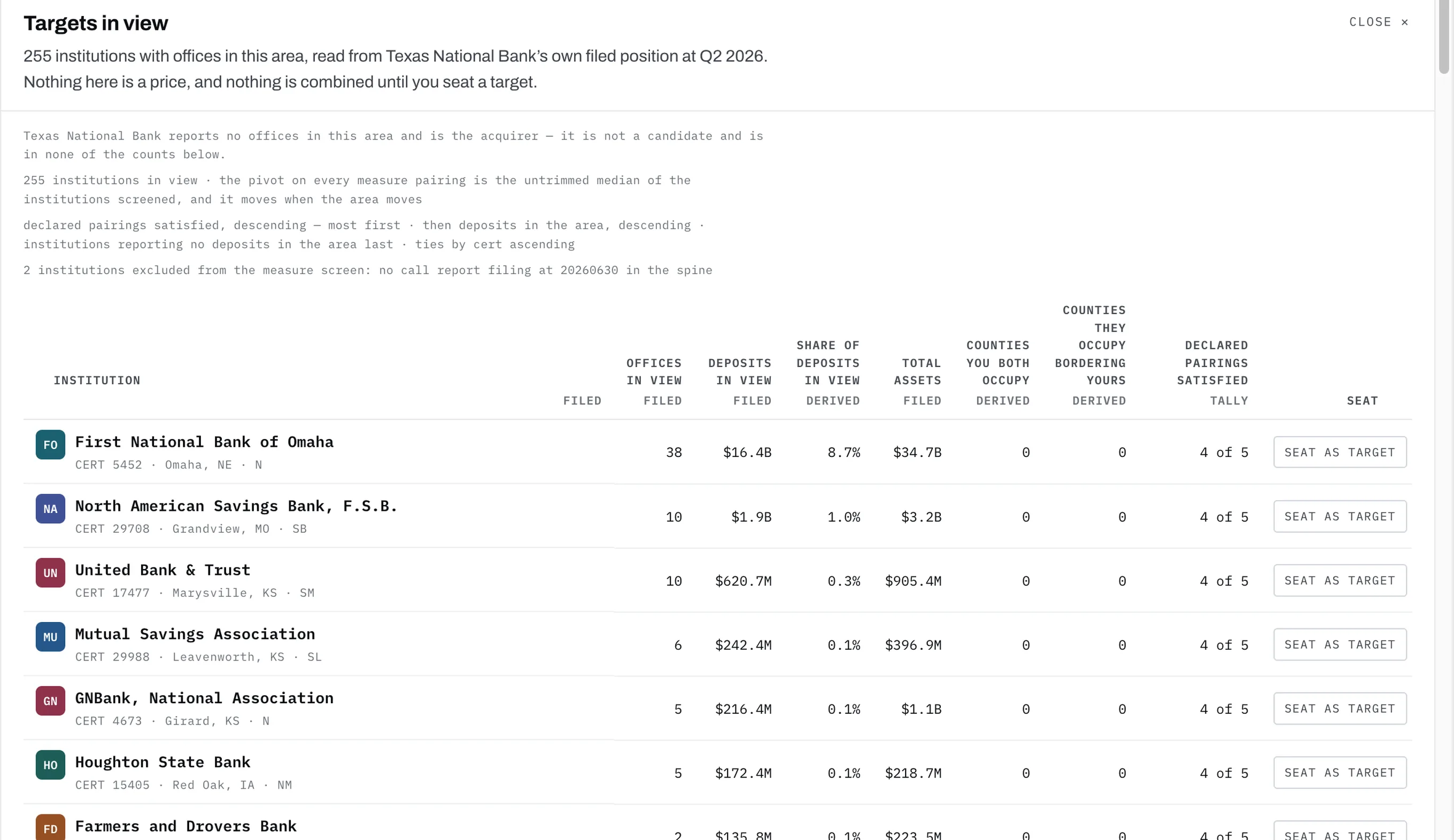
Plate. 255 institutions in view, read from the acquirer’s own filed position, every column marked filed, derived or tally. 1,581 real structural precedents sit behind the combination. Nothing here is a price. Captured 27 August 2026 · Call reports Q2 2026 · FDIC Summary of Deposits 2025 · nothing on a candidate row is combined · never a pricing comparable
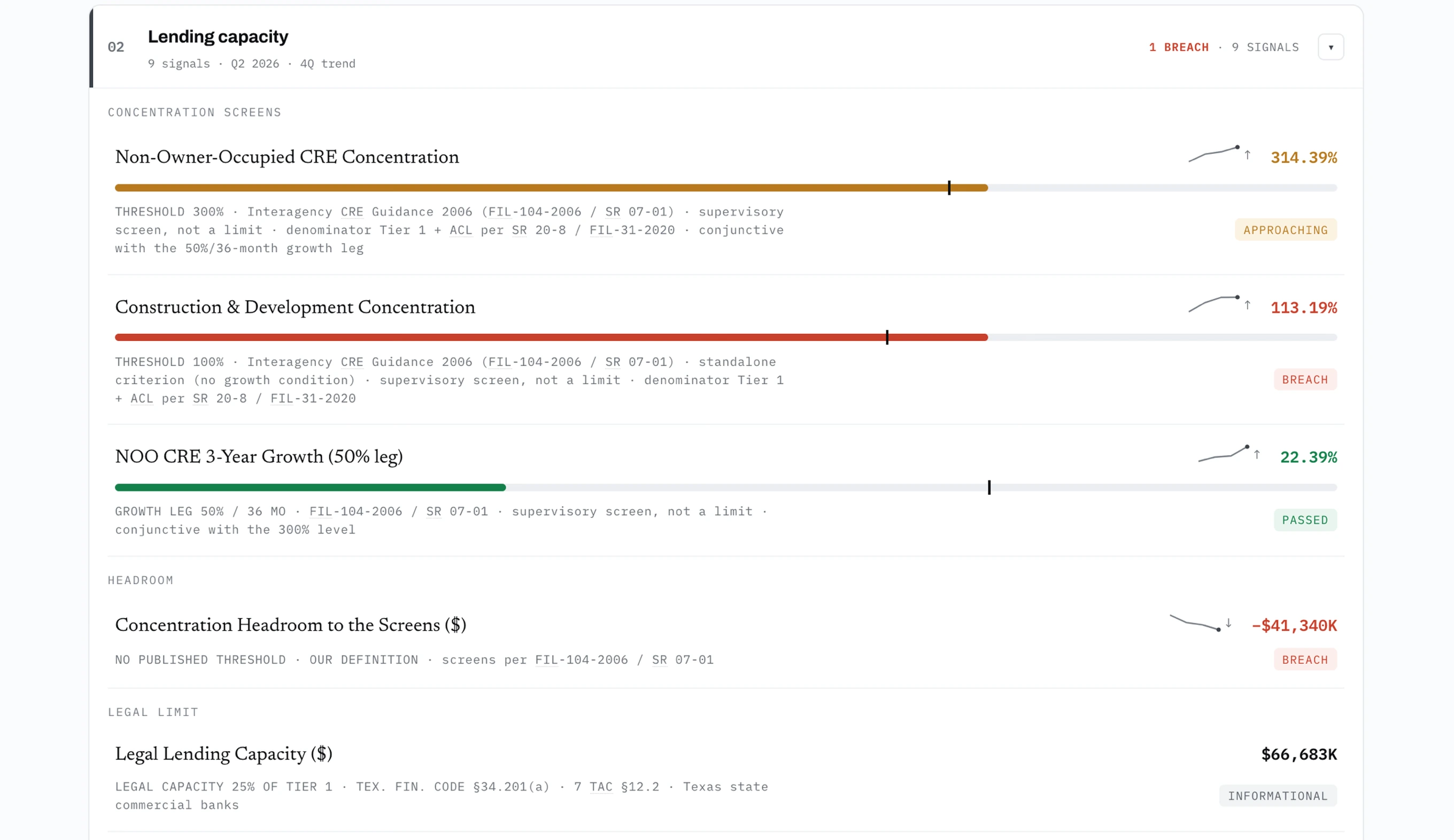
Plate. Lending capacity — nine signals of the fifty-seven, five of them in frame. Non-owner-occupied CRE sits at 314.39% against a 300% screen and reads APPROACHING, not breach: FIL-104-2006 / SR 07-01 makes that screen conjunctive with the 50%/36-month growth leg, and the leg passed at 22.39%. Captured 1 September 2026 · Call reports Q2 2026 · one institution’s filed position · the bank is not named
Free profile for every FDIC-insured bank · no login, no credit card
A call report is not a document. It is 3,929 addressable items.
Every one of them has an eight-character MDRM code naming exactly which line, on exactly which schedule, on exactly which basis. That code is the smallest unit of truth in bank regulation, and it is the unit this product is built on.
Eight characters. The first four name the reporting basis, the last four name the item.
Domestic offices, balance sheet. A bank with foreign offices files the consolidated variant instead, and conflating the two is how a peer set quietly stops comparing like with like.
One line, on one schedule, filed by one institution, on one date. Nothing about it is inferred.
Every item, on every schedule, for all 4,296 FDIC-insured institutions, back ten years. Every reading here is arithmetic over codes like this one, and will show you which.
Every number says what it is.
Holding the record is half of it. The other half is refusing to blur the difference between what your bank filed, what the FFIEC published, and what we computed.
The FFIEC is the source. We hold the record alongside their published figures, so when the two disagree we can tell you which one you are looking at rather than picking one quietly.
- A published FFIEC figure is labelled published. A figure we recomputed is labelled a recompute.
- A trimmed peer average is called a trimmed peer average. It is never called a median.
- A bank that did not report a measure is excluded from the count and never imputed, and the reading says how many were excluded.
- A coverage gap is stated on the row rather than filled in.
- Where a threshold has no published source, the row says so rather than inventing one.
- Supervisory screening criteria are called criteria, not breaches. Guidance does not carry the force of law.
Three ways to read a market you choose.
The peer set is yours to draw. Not a national cohort somebody else assigned you, and not a list of banks that happen to share an asset band.
A group from counties, a radius, or a shape you draw. Membership comes from the FDIC branch survey and every count above the map recounts as the boundary moves. Exclude a bank and it stays in your list, greyed and struck, with its offices off the map — nothing is quietly dropped from a set you built.
Every county shaded by what its offices actually reported, and the map says which of four bases it shaded on. Zoom to one market and read its competitor ladder and its concentration, including where a single branch of record is holding up a share that is not really there.
Name a target from that same map. Four honest states: summed, recomputed from components, withheld until deal terms exist, or not combinable at all. 1,581 real structural precedents sit behind it. Never a pricing comparable.
A bank that did not report a measure is excluded from n and never imputed · your own institution reads as a companion, never a member of its own median · valuation is one division over a price you entered, never an asserted value
If the filings can answer it, so can we.
The three readings above are the ones we built surfaces for. They are not the limit of what the record holds. Anything computable from a filed line item is computable here, and comes back naming the codes it was computed from.
What it will not do is answer a question the filings cannot answer. There is no model guessing at credit quality it cannot see, no predicted exam outcome, and no figure without a source.
Which banks in my state grew construction lending fastest over the last eight quarters, and where does my growth sit?
A ranked reading over filed construction and development balances, quarter by quarter, with your own institution beside the set as a companion rather than a member of it.
What happened to uninsured deposits across banks my size after March 2023?
Ten years across whatever cohort you define, with the quarters where the reporting basis itself changed marked as seams rather than smoothed over.
Who is taking deposit share in the three counties I lend in?
Branch-level share across six survey vintages, by county and by institution, with the branch-of-record distortion flagged where one office books a whole market's deposits.
Every number shows its work.
A signal is not a verdict you have to take on trust. Open one and the inspector shows the line items it read, the formula it ran, the seams in the data, and the published rule it is measured against — with the engine’s own identifier beside it, so you can go and check. Where a threshold has no published source, the row says so rather than inventing one.
The same record, read against the rules.
The exam-preparation product is not a second application with its own numbers. It reads the metrics the pages above display, one number and one source, whether it is shown on a signal row, tested by a rule, or printed in the binder you hand an examiner.
A single threshold you did not catch can define an entire exam cycle, and the work of answering for it lands on you. The difference between a finding and a footnote is timing.
Watch it read a bank you know.
Eight steps on one institution’s own filings. You pick the bank at the start, and every screen after that reads from it, so you can check the numbers against something you already know to be true.
No account, no form, no call
Every bank already has a page.
The free profile is the whole institution view for the current quarter. Nothing blurred, and nothing withheld without saying so.
One platform, not two · Intelligence and Exam Readiness are not sold separately · unlimited internal users on every plan · we scope it with you
“The tool detects. The human decides.”
MDRM IQ is an informational tool, and not a decision-making tool. It computes from public regulatory filings and cites its sources. It does not predict examination outcomes, does not value institutions, does not recommend transactions, and does not give legal, regulatory, or investment advice. Your board, your advisors and your examiners make the determinations.
Kevin Whitworth & Jason Aaberg · engine by Unomia Labs LLC
Pull your institution’s free profile.
Every domain and every citation, for the current quarter, with time still on your side.
Free · no login, no credit card · or talk to us →